The sun decides which HF bands are open; the weather fills the fax charts and the APRS beacons. How to read both, and the Ionospheric Processor that measures the sky and broadcasts it.
The sun changes from day to day: great, good, average, fair, poor or a blackout. Each condition rates every HF band good, fair, poor or closed, by day and by night, and sets the static level. In a blackout HF is dead.
An Ionospheric Processor measures it and answers a teletype's or WEFAX's SOLAR WX; a comparator on the processor reads 1 (blackout) to 6 (great).
Aurora
A blackout may bring an aurora a few days later, lighting the sky far north or south (Z beyond 10000). Under it VHF skips 500 to 4000 blocks with a raspy buzz, while HF gets worse and noisier.
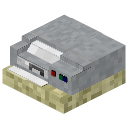
The Ionospheric Processor is the heart of a sounding station: a rack of glowing valves that sends pulses straight up through an Ionosonde Antenna and times the echoes off the sky.
With its ionosonde on the coax of its lower half it knows the solar weather; a comparator reads 1 (blackout) to 6 (great). Right click for its terminal.
On the air
Put a radio against the rack. Any WEFAX or teletype on that frequency that presses SOLR WX gets an answer under the rack's call sign (the placer's). Machines touching the rack or its radio read it directly.
Blackout alerts (on unless switched off) warn a few minutes before a blackout: WEFAX receivers that hear one print it and beep.
The terminal
[1] Timed bulletins: off by default. On, it also sends the report unasked: when it comes online, when the weather changes and every five minutes.
[2] Blackout alerts: the warnings, on by default.
[3] Send bulletin now.
It also shows its radio's frequency and any blackout forecast.
The ionosonde
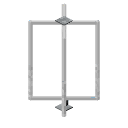
The Ionosonde Antenna is two blocks tall and goes on coax like a J-pole. It is made for sounding, not talking: on a radio it matches poorly (SWR 3 on VHF, 8 on HF).
Making a processor takes an amethyst shard among its parts.
BUILD Sounding station
Drag to turn it, scroll or pinch to zoom.
Ground layer
0aaN
Layer 2
MO
M Ionospheric Processor
N Ionosonde Antenna
O Ionosonde Antenna
a Coaxial Wire
0 Ionospheric Processor
Processor, coax and the ionosonde antenna.
Above, the build in 3D; below the 3D view, a top-down view of each layer. In game, press Visualize on this page of the handbook to see it as ghost blocks.
The WEFAX receiver prints weather charts on paper. It needs a radio with a real antenna beside it (or reached through station gear it touches), and paper: use paper on it to fill the tray, up to 64 sheets.
Each sheet takes twelve seconds to come off the drum and drops out of the front.
Buttons
WX REPT: the next chart in turn: radar, forecast, surface analysis.
SOLR WX: the solar report from an Ionospheric Processor: read directly if one touches it or its radio, otherwise asked for over the air (tune to the processor's frequency).
AUTO: prints a forecast when dangerous weather is coming.
Blackout alerts always print, with three beeps.
Alarms
The receiver puts out a redstone signal while a message prints and until its sheet is taken from the tray:
1: any message
2: a severe thunderstorm
3: a tornado or a tornado watch (a tornado is possible, though probably will not happen)
4: a hurricane
The highest of what came in counts. No paper, no message, no signal.
Put a weather station up high in the open. Right click it for the wind and gusts, temperature, humidity, pressure and the rain in the last hour (it only catches rain with open sky above it).
Any H19 terminal within 64 blocks sends that weather in its beacons, and other H19s show it with the WX symbol.
Real weather
With plain Minecraft weather there is no wind. With Another Weather Mod installed the weather is local: moving storms, wind, hail and hurricanes, and the charts and reports describe them.
Strong winds (over 33 m/s) can blow antenna parts and wire holders down. Rain halves a solar panel's output where it falls, and severe weather halves it again.



 Ionosonde Antenna