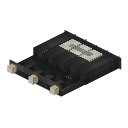
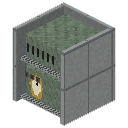
A repeater listens on its input frequency and sends what it hears out on its output, so handhelds that cannot reach each other can talk through it. Handhelds listen on the output and transmit with an offset (usually 600 kHz) to the input.
Setting up
Set a duplexer on top of it (its back or bottom work too). Run the antenna's coax from the duplexer, or from the ground straight behind the repeater, where the duplexer's cable comes down. Without one it deafens itself: "psht... psht...".
Settings: input/output, CTCSS tones, CW ID, hang time and a timeout. After you let go it holds its carrier for the hang time and beeps; when it drops, every FM radio listening gives a short "kssh" of squelch tail.
BUILD Repeater site
Drag to turn it, scroll or pinch to zoom.
Ground layer
GGGQrVr0aaJ
Layer 2
DU
D Duplexer
J J-Pole Antenna
U J-Pole Antenna
a Coaxial Wire
0 VHF Repeater
G Solar Panel
Q Charge Controller
V Large Battery
r Wire
Duplexer on the repeater, coax from behind it to the J-pole, solar power.
Above, the build in 3D; below the 3D view, a top-down view of each layer. In game, press Visualize on this page of the handbook to see it as ghost blocks.
ShapedVHF Repeater
ABACDEAFA
→
AIron Ingot
BIron Trapdoor
CCopper Ingot
DPremium VHF Base Station or VHF Base Station or Cheap VHF Base Station
The duplexer lets the repeater send and receive on one antenna at once. Its six cavity screws are tuned to frequencies: the three on the left to the output (TX), the three on the right to the input (RX). Each shows its frequency.
Tuning
A new duplexer comes tuned for the usual pair (out 146.940, in 146.340) and then follows its repeater. Turn a screw (drag or scroll) and it is yours: retune it whenever you change the repeater's frequencies. A cavity off frequency loses signal and shows the transmitter a bad SWR.
CTCSS is a low tone sent under your voice. A repeater with an access tone only repeats stations sending it. On a handheld, TXT sets the tone it sends and RXT the tone it needs to hear (tone squelch; leave it off to hear everyone), and ENTER opens the Offset page; a base station has buttons and knobs for both.
Example: repeater 146.340 in, 146.940 out: handheld on 146.940, offset -600.
Professional racks meant to be found at radio sites rather than built. None can be crafted.
The Commercial Repeater is a four-block rack that works like a VHF repeater with its duplexer, a battery and a charge controller built in: run the station's power wire to any cell of the rack, coax to an antenna, and switch it on. It transmits twice as strong as the repeater you can build, and draws twice as much to do it.
Its own battery
The wire may come from batteries, or straight from solar panels with no charge controller of your own: the rack takes what it is given and keeps its battery topped up. Pull the wire or lose the sun and it runs on from the battery, about twenty minutes listening or a few minutes of steady transmitting; the beacon on the controller cell blinks while it does.
Commercial Radio Module
A sealed four-block cabinet with its own antenna that sends one thing on one frequency, on any band, for ever. You cannot open it. What you may hear:
a numbers station: a chime, then groups of figures

 A
 B
 C
 D
 E
 F
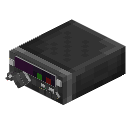 VHF Base Station or
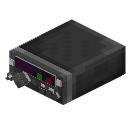 Cheap VHF Base Station